


Isn't it self explanatory?

Life seems a bit hard right now.
This is not to say that it doesn’t also feel beautiful and hopeful. Life is not so compartmentalized. The good and bad and brilliant and sad are usually jumbled in one big pile and you can choose which pieces you pick up and carry with you on a particular day.
This morning, I looked out on an ice-crystal field. And I thought about distant people and time, and out of the pile I picked out the memory of these cookies. I suppose I learned this recipe from my grandmother, Pearl. It might be more accurate to say that I “absorbed” them. I watched her make them. She never articulated them as a recipe. It’s just what you did with the dough scraps left over after you made a pie.

Have you ever made them? Don’t you love their flaky simplicity? (Hey, maybe I should name my band “Flaky Simplicity”.)
On the highly unlikely chance that you haven’t, here’s what you do:


Before you bake them, you can sprinkle them with cinnamon-sugar as my grandmother did (and I usually do). Or you can leave them naked and then dust them with powdered sugar after they come out of the oven. Or you can dip them in Nutella, or cajeta (now there’s a thought…).
They won’t change your life. They won’t erase the sad things. But that’s not their job. They’re just here to be easy, to give you a small cookie-shaped hug and remind you that everything really will be okay. And because they’re leftover scraps? Yeah, no calories either.

(Tip: You might want to play the above video while you read, to set the mood.)
There’s a cello in the corner of my bedroom.
It was a gift given to me with love (and absolutely no pressure, expectations, or obligations) from my husband and daughter. Two years ago.
I don’t know how to play the cello, but I’ve wanted to know how, for a long time now.
So here’s a question: Why am I not learning to play the cello right now?
I’ll let you in on a little not-so-secret.
I’m scared.
I’m scared of not being able to do it, or maybe I’m scared of not liking to play it as much as I’ve imagined I might. Also, I’m painfully shy and the thought of taking lessons with a real-live teacher ties my stomach up in knots. Silly I know, but all too real.
Years ago, I played violin, then guitar. I took lessons as a kid and teen, and quit over and over. Not because I didn’t want to practice or play, but because the nervous stomach I got before every lesson turned into its own sort of terror. Rather than become more comfortable the more I played, I got more nervous. I quit, and then stayed quit. My guitar and violin and cello are silent.
Aren’t we our own worst enemies?
I was reminded of this Emily Dickinson line the other day:
Not knowing when the dawn will come, I open every door.
Is she being optimistic or impatient? I find it hard to imagine reclusive, introverted Emily being that optimistic, flinging open the doors to seek the first rays of the breaking dawn.
But, I’m warm tonight, drinking a nice glass of red wind, and in a mood to be generous. Let’s go for that first interpretation. Let’s imagine Emily waking each morning, carelessly throwing a robe over her nightgown, running barefoot down the stairs to throw open the front door, then the kitchen door, the back door, the door to the garden, waiting for the thin edge of sunrise to crest the hill.
Fearless and optimistic. At least in a poem.

And indeed there will be time
To wonder, “Do I dare?” and, “Do I dare?”
Time to turn back and descend the stair,
With a bald spot in the middle of my hair—
(They will say: “How his hair is growing thin!”)
My morning coat, my collar mounting firmly to the chin,
My necktie rich and modest, but asserted by a simple pin—
(They will say: “But how his arms and legs are thin!”)
Do I dare
Disturb the universe?
In a minute there is time
For decisions and revisions which a minute will reverse.–T.S. Eliot, from “The Love Song of J. Alfred Prufrock”
I spend more time than I care to admit worrying about disturbing the universe. Offending someone. Bothering someone. Annoying someone. But who cares what I do, really? Who will be offended if I play the wrong note, or look foolish, or can’t hold the bow correctly?
What’s stopping me?
What’s stopping you from doing the thing you dream of doing?
Do we dare?
Wouldn’t it be awfully splendid to be able to play like Zoe?

If you were reading this blog last year this time, you’ll remember that we followed Robert Falcon Scott in his journey to the South Pole and back (or nearly).
100 years ago today, eight months after Scott and the polar party perished, just 11 miles from One Ton Depot, where extra fuel and food was cached, the bodies of the polar party were found.
The polar party had never returned to Hut Point from their attempt on the pole the previous year. Those remaining at Hut Point waited, not knowing if Scott and his party had reached the pole or not. As winter came on, they began to worry, but continued under order to resupply One Ton, hoping to meet Scott there (perhaps delayed by storms or illness). They made at least two other attempts that winter to find Scott’s party before determining that the pole party likely had perished.
On October 29, 1912, a search party set out with a team of mules. On November 12, they came upon the snow-covered tent that contained the frozen bodies of Scott, Wilson, and Bowers. In the tent, they also found letters and journals that detailed the horrible journey, up until the expedition’s last hours.
In addition to the letters Scott wrote to the public, there was this heartbreaking letter of farewell to his wife, Kathleen.

You can read the transcript of this letter here, at the wonderful blog, Letters of Note.
Equally moving is Apsley Cherry-Garrard’s account of the discovery of the bodies. Cherry-Garrard, as a member of the Antarctic expedition and search party, recorded the events in his book, The Worst Journey in the World:
November 12 [1912]… Nearly mid-day. 11-12 miles south of One Ton. We have found them—to say it has been a ghastly day cannot express it—it is too bad for words. The tent was there, about half-a-mile to the west of our course, and close to a drifted-up cairn of last year. It was covered with snow and looked just like a cairn, only an extra gathering of snow showing where the ventilator was, and so we found the door.
It was drifted up some 2-3 feet to windward. Just by the side two pairs of ski sticks, or the topmost half of them, appeared over the snow, and a bamboo which proved to be the mast of the sledge.
Their story I am not going to try and put down. They got to this point on March 21, and on the 29th all was over.
Nor will I try and put down what there was in that tent. Scott lay in the centre, Bill on his left, with his head towards the door, and Birdie on his right, lying with his feet towards the door.
Bill especially had died very quietly with his hands folded over his chest. Birdie also quietly.
Oates’ death was a very fine one. We go on to-morrow to try and find his body. He was glad that his regiment would be proud of him.
They reached the Pole a month after Amundsen.
We have everything—records, diaries, etc. They have among other things several rolls of photographs, a meteorological log kept up to March 13, and, considering all things, a great many geological specimens. And they have stuck to everything. It is magnificent that men in such case should go on pulling everything that they have died to gain. I think they realized their coming end a long time before. By Scott’s head was tobacco: there is also a bag of tea.
Atkinson gathered every one together and read to them the account of Oates’ death given in Scott’s Diary: Scott expressly states that he wished it known. His (Scott’s) last words are:
“For God’s sake take care of our people.”
Then Atkinson read the lesson from the Burial Service from Corinthians. Perhaps it has never been read in a more magnificent cathedral and under more impressive circumstances—for it is a grave which kings must envy. Then some prayers from the Burial Service: and there with the floor-cloth under them and the tent above we buried them in their sleeping-bags—and surely their work has not been in vain.[291]
That scene can never leave my memory. We with the dogs had seen Wright turn away from the course by himself and the mule party swerve right-handed ahead of us. He had seen what he thought was a cairn, and then something looking black by its side. A vague kind of wonder gradually gave way to a real alarm. We came up to them all halted. Wright came across to us. ‘It is the tent.’ I do not know how he knew. Just a waste of snow: to our right the remains of one of last year’s cairns, a mere mound: and then three feet of bamboo sticking quite alone out of the snow: and then another mound, of snow, perhaps a trifle more pointed. We walked up to it. I do not think we quite realized—not for very long—but some one reached up to a projection of snow, and brushed it away. The green flap of the ventilator of the tent appeared, and we knew that the door was below.
Two of us entered, through the funnel of the outer tent, and through the bamboos on which was stretched the lining of the inner tent. There was some snow—not much—between the two linings. But inside we could see nothing—the snow had drifted out the light. There was nothing to do but to dig the tent out. Soon we could see the outlines. There were three men here.
Bowers and Wilson were sleeping in their bags. Scott had thrown back the flaps of his bag at the end. His left hand was stretched over Wilson, his lifelong friend. Beneath the head of his bag, between the bag and the floor-cloth, was the green wallet in which he carried his diary. The brown books of diary were inside: and on the floor-cloth were some letters.
Everything was tidy. The tent had been pitched as well as ever, with the door facing down the sastrugi, the bamboos with a good spread, the tent itself taut and shipshape. There was no snow inside the inner lining. There were some loose pannikins from the cooker, the ordinary tent gear, the personal belongings and a few more letters and records—personal and scientific. Near Scott was a lamp formed from a tin and some lamp wick off a finnesko. It had been used to burn the little methylated spirit which remained. I think that Scott had used it to help him to write up to the end. I feel sure that he had died last—and once I had thought that he would not go so far as some of the others. We never realized how strong that man was, mentally and physically, until now.
We sorted out the gear, records, papers, diaries, spare clothing, letters, chronometers, finnesko, socks, a flag. There was even a book which I had lent Bill for the journey—and he had brought it back. Somehow we learnt that Amundsen had been to the Pole, and that they too had been to the Pole, and both items of news seemed to be of no importance whatever. There was a letter there from Amundsen to King Haakon. There were the personal chatty little notes we had left for them on the Beardmore—how much more important to us than all the royal letters in the world.
We dug down the bamboo which had brought us to this place. It led to the sledge, many feet down, and had been rigged there as a mast. And on the sledge were some more odds and ends—a piece of paper from the biscuit box: Bowers’ meteorological log: and the geological specimens, thirty pounds of them, all of the first importance. Drifted over also were the harnesses, ski and ski-sticks.
Hour after hour, so it seemed to me, Atkinson sat in our tent and read. The finder was to read the diary and then it was to be brought home—these were Scott’s instructions written on the cover. But Atkinson said he was only going to read sufficient to know what had happened—and after that they were brought home unopened and unread. When he had the outline we all gathered together and he read to us the Message to the Public, and the account of Oates’ death, which Scott had expressly wished to be known.
We never moved them. We took the bamboos of the tent away, and the tent itself covered them. And over them we built the cairn.
I do not know how long we were there, but when all was finished, and the chapter of Corinthians had been read, it was midnight of some day. The sun was dipping low above the Pole, the Barrier was almost in shadow. And the sky was blazing—sheets and sheets of iridescent clouds. The cairn and Cross stood dark against a glory of burnished gold.


Fun fact #1: I still cannot write the word “Friend” without singing this song to myself.
Fun fact #2: In the late 60s/early 70s, my father worked for the public television station WQED, where he was Production Manager and Lighting Director for Mister Rogers’ Neighborhood (among other shows). That porch swing? I sat on it. Those fish? I fed them. I rang the bell at Lady Elaine Fairchild’s museum, swung the pendulum on Daniel Stripèd Tiger’s grandmother clock. I snuck behind the tree where X the Owl and Henrietta Pussycat lived. And, like most of the other kids watching the show, when Mister Rogers sang, “You are Special,” I truly believed he was singing it right to me.
It’s been one of those weeks. We need a smile. Don’t you?
How about a cute baby hedgehog?
http://youtu.be/b-Ty7p6tW1A
Or a chat exchange between a man and his cat?
Or bad pun art?
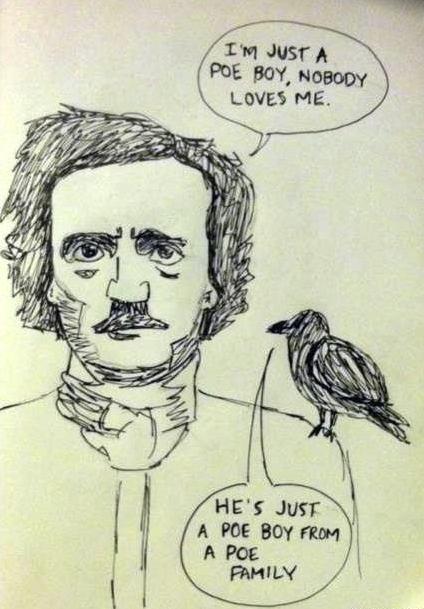
Or an internet-meme referencing lolcat?

Or a funny cat video?
Or a list of poetry journal names that reflect the true nature of writing poetry?
Or maths?
http://vimeo.com/13497928
“3 equaling “Hello”? Suddenly it all makes sense…

Well, here we are, November.
You and I don’t get along so well. I resent you for stealing my summer warmth. You blithely turn the sun off at 4.15 pm. You freeze the water in the goat’s water buckets every night. You slither your brittle, windy fingers through the walls in this old house. What’s worse, you seem indifferent to my whining.
This month’s Let’s Lunch theme is gratitude. And I admit at first I found little to be grateful for. Because I’m a November grumpy pants.
But even just a few minutes of making a list of all I have to be grateful for yielded an embarrassment of riches (not to mention my embarrassment at not knowing how to spell “embarrassment”).
Health, family, shelter, power, heat, functioning limbs and brain, warm food when I need it, freedom, choice, a light I can switch on when the sun sets, seemingly limitless clean water rushing out of the faucet.
How many people on earth can claim that list? How many people, even on just the east coast of the United States are without warmth and light right now, on this bitter, November-swept day? How many people around the world live in fear, under persecution, without freedom, without adequate food, or healthcare, or clean water?
When I wrote “embarrassment”, I wasn’t joking.
So, in gratitude, I decided to make this simple, unadorned, most basic thing to share for our lunch: a sourdough loaf of bread, from my favorite pain au levain recipe, by James MacGuire.
(Note that the original recipe is a fourteen-page long, wonderful tour through the history of french sourdough breads in issue 83 of The Art of Eating. The recipe I’ve linked to here is a slightly adapted version of that recipe.)


Flour, water, salt, wild yeast.
Hands, time, heat.
That’s all you need. Plus a little bit of patience.
You don’t even need a mixer, or a spoon.
This is a slow bread, made by mixing the dough with one hand, then “folding” the dough once an hour for four hours.
If you’re at home on a quiet weekend day, you can easily fit it into your schedule: fold for thirty seconds, go back to reading your book in front of the fire, or playing “Careers” with your kids, or raking the lawn. Visit the bread in another hour and see how it’s changed, give it another quick fold. Go back to the laundry, or making soup, or those phone calls you have to make.
You see how it goes.
Gratitude. It can be tangible. And eaten with a slice of perfectly aged goat cheese.
I only wish I could sit down at a table tonight and share it with you.

Here’s a complete list of the recipes of gratitude made this month by the Let’s Lunch crew (I’ve included my own at the bottom for completeness). Check them out!
Gratitude “Plumb” Cake from Lisa at Monday Morning Cooking Club
Gratitude Fried Rice from Linda at spicebox travels
Seafood Chowder from Lucy at A Cook and Her Books
Cracked Black Pepper and Blue Cheese Crackers (gluten free) from Charissa at Zest Bakery
A Thanksgiving tablecloth tradition from Lucy at In a Southern Kitchen
Gratitude Soup from Rashda at Hot Curries and Cold Beer
Pumpkin Muffins with Cinnamon Sugar (gluten free) from Linda at Free Range Cookies
Pumpkin Roll with Pecans from Annabelle at a Glass of Fancy
5-Minute Wonder Soup from Eleanor at Wok Star
Green Tomato Salad from Renee at My Kitchen and I
Asian-Style Pickled Oyster Mushrooms from Joe at Joe Yonan
Pain au levain from Rebecca at GrongarBlog


The Sea
Do I ever wonder? You don’t know.
You’ll never follow, and I’ll never show.
D’you see the water and watch it flow
And float an empty shell,
And you think that I’m hiding from the island.
You’ve a fault in your senses. Can you feel it now?
Time? What is that? I’ve no time to care.
I’ve lived for a long while nearly everywhere.
You will be taken, everyone, you ladies and you gentlemen.
Fall and listen with your ears upon the paving stone.
Is that what you hear? The coming of the sea?
Sea flows under your doors in London town.
And all your defenses are all broken down.
You laugh at me on sunny days, but mine’s the slight of hand.
Don’t you know I am a joker, a deceiver?
And I’m waiting for the land.
–Sandy Denny