What’s next?

Complete

I have so many things to tell you.

April was a frenzy of activity. It was wonderful but it moved so quickly I’d no time to pin it down here in words. I’ll try to make up for that in May, but right now, I just want to crow for a moment… I completed the PoMoSco challenge!

I wrote and posted a new found poem every day through the month of April.

I did it! And I even wrote some poems I really like.

Yes.

Okay, crowing over. There’s so much more to be done: spring flowers to coax, poems to write, goats and bees to tend, cats to outwit, dogs to run, musicals to attend, tomatoes to turn into jam.

Let’s get a move on, shall we?

~~~~~~~~~~~~~~~~~~~~~~~~~~~~~~

For those who missed it, I posted a link to a poem each day in April that somehow related to the PoMoSco badge of the day. You can see the full list of those poems/links here.

The PoMoSco poems (nearly 4000!) are available to read through the end of May 2015. So if you have a spare moment, stop by the site and just pick one at random to read. There are some really terrific poems here — many you’d never guess are from found material.

The poem I linked to for the final badge (Order’s Up) is one I just love. If you know me even a little bit, you’ll understand why. I’m posting it here in case you missed it:

Paris – Forfar

From the window of the Hardie-Condie Café, I see the ghost of a rich
friend of my grandmother drive down Forfar’s Main Street in a Rolls-
Royce I was sick in as a child. Behind me the watercolours of stick girls
walking through trees are misted blobs percolating in coffee steam.
Mother comes in like Scott of the Antarctic carrying tents of shopping.
The garçon brings a cappucino and croissants on which she wields her
knife with the off-frantic precision of violins in Hitchock’s shower scene.
Soon I will tell her. Show her dust in the sugar spoon. Her knife gouges
craters in the dough like an ice-axe and she tells the story on nineteen
Siberian ponies she queued behind in the supermarket. Of Captain
Oates who boxed her fallen ‘Ariel’. The chocolate from the cappucino
has gone all over her saucer. There is a scene and silence. Now tell her.
Tell her above the coffee table which scrapes with the masked voice of a
pier seeming to let in some waters, returning others to the sea, diverting
the pack-ice which skirts around its legs. Tell her a fact about you she
knows but does not know and which you will tell her except that the
surviving ponies are killed and the food depot named Desolation Camp
made from their carcasses keeps getting in the way. From this table we
will write postcards, make wireless contact with home and I will tell her
of King Edward VII Land, of how I have been with Dr Wilson and then
alone, so alone, in day-blizzards just eleven miles short of the Pole and
ask her to follow me. I am afraid she has been there already. She smiles
like the Great Beardmore Glacier and goes out into the street with stick
girls to the thirty-four sledgedogs and the motor-sledges. You are too
late. Amundsen is in Forfar. She has an appointment. Behind me I can
sense the canvases, the dried grasses pressed into their grain like eczema
on an open palm. Later I will discover her diary and what I told her.

–David Kinloch, from Paris – Forfar (Polygon, 1994)

~~~~~~~~~~~~~~~~~~~~~~~~~~~~~~

Update: May 10, 2015. The PoMoSco Scoutmasters posted badge rankings today. The total possible points awarded were 600. Look how many of us completed all the badges!

PoMoScoRankings

RMSFinalPoMoSco

If you talk about it long enough you’ll finally write it

PoMoSco-Website-Badge-2As much jabbering as I do here about myself, there are probably still one or two things you don’t know about me.

Here’s one: when I was little I was a Brownie, and then I “flew up” to become a Junior Girl Scout, and then, after the novelty of wearing my uniform and sash with badges to school once a week on meeting days wore off, I gave all that up. I’m not really a joiner.

When I first became a Brownie, the thing that interested me most about the whole affair was the manual. It was a square, orange-colored, soft-covered reference book that contained all you needed to know about being a good Brownie: the uniform details, how to wear the sash, the story of how the Brownies came to be, a comprehensive list of all the badges you could earn, the pledges you would recite, the behavior expected of you at meetings and in your community, the songs you would need to memorize, the suggested games and activities for Brownie meetings.

As I remember it, near the back of the book (but it could have been anywhere), there were sketches of Girl Scouts in their uniforms. The dimple-faced Brownie in her brown outfit, the Junior in her green. As you progressed through the evolution from Brownie to Senior, the uniforms (always a dress or a skirt, mind you, back in those days) got more elegant to my mind. The older girls wore cute berets worn slightly askew…. and white gloves. I gave serious consideration to whether I could tough it out long enough to get to white glove stage. Then I thought better of it and went back to my blue jeans and model horses.

I spent a lot of time in that book. More time, in fact, than I spent at meetings or activities. I didn’t much enjoy the activities, but, even back then, grade 2 or 3, I really dug a reference book.

Some things never change.

Why am I telling you this?

Well, today starts National Poetry Month and though I agree with Mary Ruefle that November could use more poetic attention, I don’t see any reason why we shouldn’t cram the year with a much poetry as possible, so why not celebrate poetry in April? This year, as in past years, I’ll mark the occasion by adding a new poem to this post every day for the month.

On top of that, I’m going back to scouting. Poetry scouting, that is. I’ll be participating in the Found Poetry Review’s  PoMoSco project, where I and 212 other poetry scouts (representing 43 states and 12 countries) will be creating and posting a new found poem every day for the month of April.

Each day there’s a new type of found poetry to compose, a new badge to earn. Through March, I’ve been preparing by gathering source texts and writing some first drafts, but today is when it all becomes real.

Enough talk; it’s time to write.

~~~~~~~~~~~~~~~~~~~~~~~~~~

Details for Paterson

I just saw two boys.
One of them gets paid for distributing circulars
and he throws it down the sewer.

I said, Are you a Boy Scout?
He said, no.
The other one was.
I have implicit faith in
the Boy Scouts

If you talk about it
long enough
you’ll finally write it—
If you get by the stage
when nothing
can make you write—
If you don’t die first

I keep those bests that love
has given me
Nothing of them escapes—
I have proved it
proven once more in your eyes

Go marry! your son will have
blue eyes and still
there’ll be no answer
you have not found a cure
No more have I for that enormous
wedged flower, my mind
miraculously upon
the dead stick of night

–William Carlos Williams, From The Collected Poems of William Carlos Williams. Copyright © 1988 by Christopher MacGowan

That’s a bonus poem for you.

From now on, I’ll be adding a link each day to a poem that somehow relates to the day’s PoMoSco badge category (in parentheses). I hope you’ll also visit us over on the PoMoSco site to see our poems there. (If you want to see the poems I’m writing, you can get there by using this direct link.)

April 1 (Pick and Mix) ~ Pick ‘n’ Mix , by Holly Magill
April 2 (Shake it Up) ~ Back Yard, by Carl Sandburg
April 3 (White Out) ~ Departure and Departure and…, by George Bruce
April 4 (On Demand) ~ The Grind, by Ange Mlinko
April 5 (All Ears) ~ LXI, by César Vallejo
April 6 (First in Line) ~ Louisiana Line, by Betty Adcock
April 7 (Roll the Dice) ~ Here, by Arthur Sze
April 8 (Redacted) ~ a little bit of poetry, by tychogirl
April 9 (X:Y) ~ X Minus X, by Kenneth Fearing
April 10 (Interloper) ~ The Interloper, by Thomas Hardy
April 11 (Haiku Anew) ~ Not That It’s Loneliness, by Chloe Moorish
April 12 (Chance Walk) ~ A Late Walk, by Robert Frost
April 13 (Picture It) ~ Picture of Little Letters, by John Koethe
April 14 (Survey Says) ~ Phone Survey, by Carole Langille
April 15 (As Advertised) ~ The Letter, by Dana Gioia
April 16 (Blender) ~ Miniature Delights, by Anne Ryland
April 17 (Spelling B) ~ I Wave Good-bye When Butter Flies, by Jack Prelutsky
April 18 (Open Book) ~ Granted, by Maxine Chernoff
April 19 (Quiet on Set) ~ Passing Through, by D.A. Powell
April 20 (Off the Shelf) ~ Canada, by Billy Collins
April 21 (Interrogator) ~ The Wrong Question, by Anne Swannell
April 22 (Dialed In) ~ The Farm on the Great Plains, by William E. Stafford
April 23 (Click Trick) ~ The South Transept Window, St. Lucia at Lowhampton, by Martin Monahan
April 24 (Best Laid Plan) ~ To a Mouse, by Robert Burns
April 25 (Crowdsource) ~ Out of the Rolling Ocean, the Crowd, by Walt Whitman
April 26 (Pinch an Inch) ~ The Sciences Sing a Lullabye, by Albert Goldbarth
April 27 (Spaced Out) ~ Theories of Time and Space, by Natasha Trethewey
April 28 (Cut it Out) ~ Cut Out For It, by Kay Ryan
April 29 (Substitute Texter) ~ The Steam Engine, by Elizabeth Wills
April 30 (Order’s Up) ~ Paris – Forfar, by David Kinloch

The root of the root

The root of the root

i carry your heart with me(i carry it in
my heart)i am never without it(anywhere
i go you go,my dear;and whatever is done
by only me is your doing,my darling)
                                                    i fear
no fate(for you are my fate,my sweet)i want
no world(for beautiful you are my world,my true)
and it’s you are whatever a moon has always meant
and whatever a sun will always sing is you

here is the deepest secret nobody knows
(here is the root of the root and the bud of the bud
and the sky of the sky of a tree called life;which grows
higher than soul can hope or mind can hide)
and this is the wonder that’s keeping the stars apart

i carry your heart(i carry it in my heart)

–E. E. Cummings, Copyright 1952, © 1980, 1991 by the Trustees for the E. E. Cummings

A brightness

Is the coast clear?

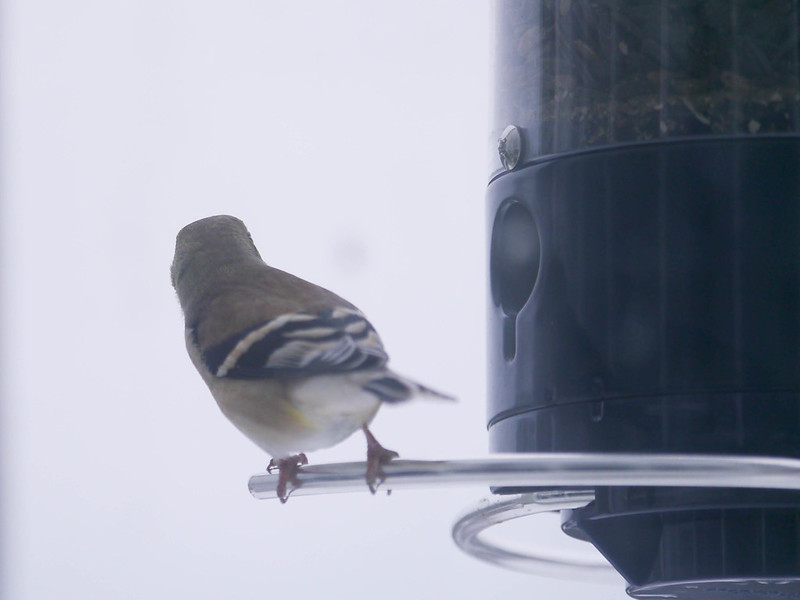
Bird at the Window

Beyond is a brightness
I am not equal to

Yet what I see
Turns into what I want,

And to bring nothing but this body
To pass through

The one thing between
Myself and what I crave,

Almost done, the world a ruin
Of leaves, winter at the throat,

My song over and over until
So familiar I can do

What I am about to do
While you who rise from the table

And walk from room to room
Will remember only the sound

Of what cast herself through
All that glass, instead of the song

That was sung until finally
You would ask to know more.

–Sophie Cabot Black, Poetry (June 2008)

Time passes. Listen.

Bees' first winter

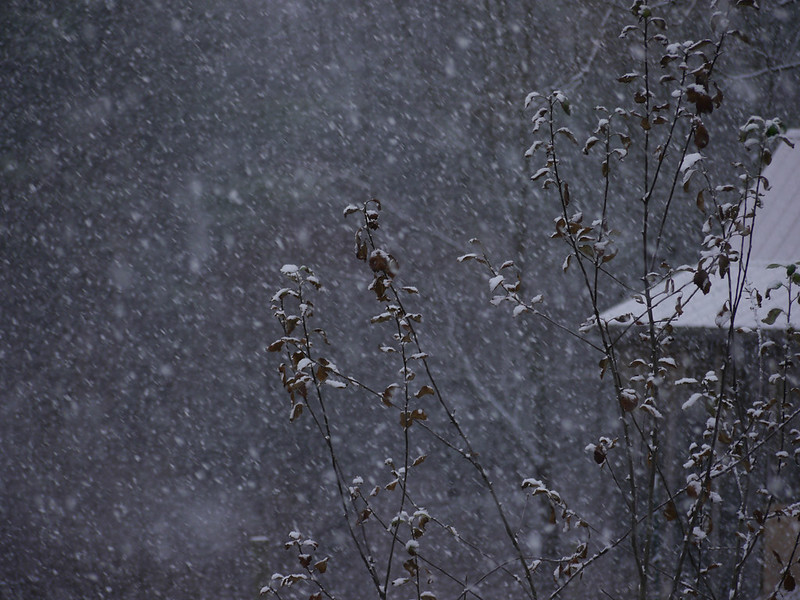
Pedants will tell me that it’s not officially winter yet, but let’s not quibble. Zero degrees F on the thermometer this morning, snow and ice solidly gripping the ground, Elliot the blueberry bush up to his neck in snow, another nor’easter roaring up the coast tomorrow.

Let’s call a winter a winter.

Today I watched the shivery sun sprint for the western horizon as if, like me, he just couldn’t wait to be in bed, under the covers, with a pile of books laid by. I swear he was behind the hill by 3 pm. And I know tomorrow I’ll see even less of him, minute by minute.

Watching the light rise and fall this time of year, a person can’t help but be obsessed a bit by the ticking by of seconds, to become a hoarder of sunlit minutes, to think of time as something solid you can put in your pocket and rub your thumb over during the day, wearing it down grain by grain.

This time of year, the night is an ocean. You can’t see the other side. But you can sail its surface. A story is like a puff of wind in your sail. This weekend, we went to our local theater to hear a story: Dylan Thomas’ “Under Milk Wood.”

I can try to describe to you how the play mesmerized me, how the chewy-lyrical language lulled the audience, then made us laugh, then cracked our hearts. I could tell you how we watched the minutes of a day in the village of “Llareggub” slide by, night to dawn to noon to dusk to night. I could tell you how we lived a day through the night, then, outside, how the moon was hidden but the poem was a light reflected in the snow.

But I can’t tell it anywhere as well Dylan Thomas and Richard Burton can tell it. So why even try?

[youtube https://www.youtube.com/watch?v=uuPO2Kvqlms&w=640&h=480]

[Silence]

FIRST VOICE (_Very softly_)

To begin at the beginning:

It is spring, moonless night in the small town, starless
and bible-black, the cobblestreets silent and the hunched,
courters’-and-rabbits’ wood limping invisible down to the
sloeblack, slow, black, crowblack, fishingboatbobbing sea.
The houses are blind as moles (though moles see fine to-night
in the snouting, velvet dingles) or blind as Captain Cat
there in the muffled middle by the pump and the town clock,
the shops in mourning, the Welfare Hall in widows’ weeds.
And all the people of the lulled and dumbfound town are
sleeping now.

Hush, the babies are sleeping, the farmers, the fishers,
the tradesmen and pensioners, cobbler, schoolteacher,
postman and publican, the undertaker and the fancy woman,
drunkard, dressmaker, preacher, policeman, the webfoot
cocklewomen and the tidy wives. Young girls lie bedded soft
or glide in their dreams, with rings and trousseaux,
bridesmaided by glowworms down the aisles of the
organplaying wood. The boys are dreaming wicked or of the
bucking ranches of the night and the jollyrodgered sea. And
the anthracite statues of the horses sleep in the fields,
and the cows in the byres, and the dogs in the wetnosed
yards; and the cats nap in the slant corners or lope sly,
streaking and needling, on the one cloud of the roofs.

You can hear the dew falling, and the hushed town breathing.
Only _your_ eyes are unclosed to see the black and folded
town fast, and slow, asleep. And you alone can hear the
invisible starfall, the darkest-beforedawn minutely dewgrazed
stir of the black, dab-filled sea where the _Arethusa_, the
_Curlew_ and the _Skylark_, _Zanzibar_, _Rhiannon_, the _Rover_,
the _Cormorant_, and the _Star of Wales_ tilt and ride.

Listen. It is night moving in the streets, the processional
salt slow musical wind in Coronation Street and Cockle Row,
it is the grass growing on Llaregyb Hill, dewfall, starfall,
the sleep of birds in Milk Wood.

Listen. It is night in the chill, squat chapel, hymning in
bonnet and brooch and bombazine black, butterfly choker and
bootlace bow, coughing like nannygoats, sucking mintoes,
fortywinking hallelujah; night in the four-ale, quiet as a
domino; in Ocky Milkman’s lofts like a mouse with gloves;
in Dai Bread’s bakery flying like black flour. It is to-night
in Donkey Street, trotting silent, With seaweed on its
hooves, along the cockled cobbles, past curtained fernpot,
text and trinket, harmonium, holy dresser, watercolours
done by hand, china dog and rosy tin teacaddy. It is night
neddying among the snuggeries of babies.

Look. It is night, dumbly, royally winding through the
Coronation cherry trees; going through the graveyard of
Bethesda with winds gloved and folded, and dew doffed;
tumbling by the Sailors Arms.

Time passes. Listen. Time passes.

Come closer now.

Only you can hear the houses sleeping in the streets in the
slow deep salt and silent black, bandaged night. Only you
can see, in the blinded bedrooms, the coms. and petticoats
over the chairs, the jugs and basins, the glasses of teeth,
Thou Shalt Not on the wall, and the yellowing dickybird-watching
pictures of the dead. Only you can hear and see, behind the
eyes of the sleepers, the movements and countries and mazes
and colours and dismays and rainbows and tunes and wishes
and flight and fall and despairs and big seas of their dreams.

From where you are, you can hear their dreams.

The moon’s watching

Winter Trees

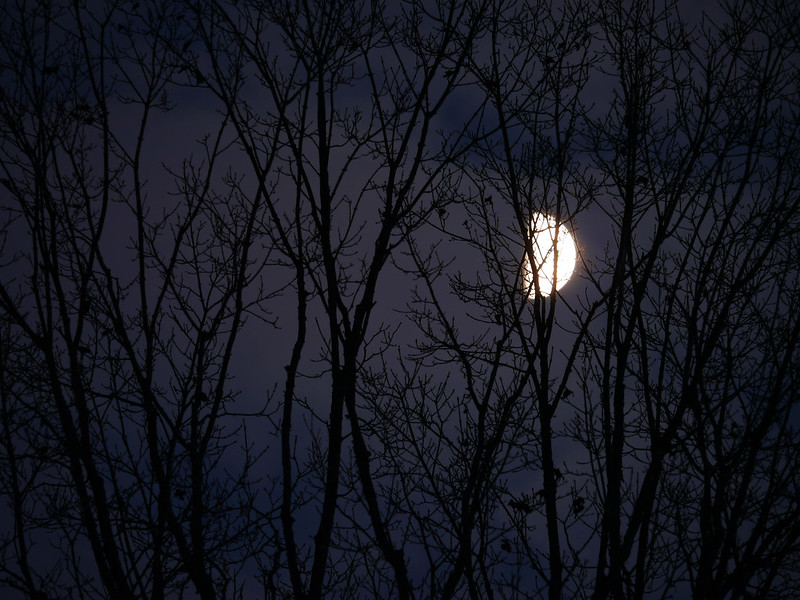
Earlier this evening I spied on the moon through the branches of the huge Maple tree in our yard. Now, when I’m here at my desk, wondering what on earth to write about, the moon is spying on me (M told me so just a minute ago).

What can I possibly write that the moon hasn’t already read?

What can I do but describe the cold blue-black night, the dying glow of the fires, the dogs lying like moored boats in a moonlit harbor, another load of dirty dishes piled in the sink, the stereo playing some piece of music I feel I know but can’t name, the moon sailing her orbit while we sail ours, the end of the day.

Same old story, says the moon in a comforting way. Time to turn out the lights, pull the night up to your chin, feel quiet and planted, like a Maple tree on a November night.

Winter Trees

All the complicated details
of the attiring and
the disattiring are completed!
A liquid moon
moves gently among
the long branches.
Thus having prepared their buds
against a sure winter
the wise trees
stand sleeping in the cold.

–William Carlos Williams

Too many to list

Sticking


A List of Praises

Give praise with psalms that tell the trees to sing,
Give praise with Gospel choirs in storefront churches,
Mad with the joy of the Sabbath,
Give praise with the babble of infants, who wake with the sun,
Give praise with children chanting their skip-rope rhymes,
A poetry not in books, a vagrant mischievous poetry
living wild on the Streets through generations of children.

Give praise with the sound of the milk-train far away
With its mutter of wheels and long-drawn-out sweet whistle
As it speeds through the fields of sleep at three in the morning,
Give praise with the immense and peaceful sigh
Of the wind in the pinewoods,
At night give praise with starry silences.

Give praise with the skirling of seagulls
And the rattle and flap of sails
And gongs of buoys rocked by the sea-swell
Out in the shipping-lanes beyond the harbor.
Give praise with the humpback whales,
Huge in the ocean they sing to one another.

Give praise with the rasp and sizzle of crickets, katydids and cicadas,
Give praise with hum of bees,
Give praise with the little peepers who live near water.
When they fill the marsh with a shimmer of bell-like cries
We know that the winter is over.

Give praise with mockingbirds, day’s nightingales.
Hour by hour they sing in the crepe myrtle
And glossy tulip trees
On quiet side streets in southern towns.

Give praise with the rippling speech
Of the eider-duck and her ducklings
As they paddle their way downstream
In the red-gold morning
On Restiguche, their cold river,
Salmon river,
Wilderness river.

Give praise with the whitethroat sparrow.
Far, far from the cities,
Far even from the towns,
With piercing innocence
He sings in the spruce-tree tops,
Always four notes
And four notes only.

Give praise with water,
With storms of rain and thunder
And the small rains that sparkle as they dry,
And the faint floating ocean roar
That fills the seaside villages,
And the clear brooks that travel down the mountains

And with this poem, a leaf on the vast flood,
And with the angels in that other country.

–Anne Porter, from Living Things. Copyright © 2006

On this warm November day

Nature (1/5)

The Birds

are heading south, pulled
by a compass in the genes.
They are not fooled
by this odd November summer,
though we stand in our doorways
wearing cotton dresses.
We are watching them

as they swoop and gather—
the shadow of wings
falls over the heart.
When they rustle among
the empty branches, the trees
must think their lost leaves
have come back.

The birds are heading south,
instinct is the oldest story.
They fly over their doubles,
the mute weathervanes,
teaching all of us
with their tailfeathers
the true north.

–Linda Pastan, from The Imperfect Paradise. Copyright © 1988

Fire – Cat – Stevens – Wallace – Firecat

Firecat

[youtube https://www.youtube.com/watch?v=W4-IZTZkTY8&w=420&h=315]

Earthy Anecdote

Every time the bucks went clattering
Over Oklahoma
A firecat bristled in the way.

Wherever they went,
They went clattering,
Until they swerved
In a swift, circular line
To the right,
Because of the firecat.

Or until they swerved
In a swift, circular line
To the left,
Because of the firecat.

The bucks clattered.
The firecat went leaping,
To the right, to the left,
And
Bristled in the way.

Later, the firecat closed his bright eyes
And slept.

–Wallace Stevens