Plink!

photo courtesy of Fashionslide (via Wikipedia)

The Pachinko Machine

If I remember it right
they found it at a Sears store
incongruous
among the hammers
lawn mowers
washing machines
garden hoses
rain jackets

(remember the Sears nut counter, where you could buy a warm paper bag of red-skinned peanuts while you shopped for nails and screws?)

They stood, looking at it,
for a sweet long time
talking to the salesman.
The pachinko machine
stood there, mute,
exotic, beautiful, unnecessary.

(how did it get here, from Japan to this midwestern hardware store? who signed his name to this shipment?)

My parents were generally
frugal and practical. This was not
the sort of thing they bought.
My grammar school heart raced:
“Please oh please oh please.”

I imagined hours of joy,
pressing that lever,
rocketing the shiny metal balls
to the top of the game
then watching them fall like hail,
plinking and jumping
among the wire pins,
willing them along the certain path
to release a fortune in shiny metal balls.

My heartbeat pleas
plinked in my chest.
“Please do this one wild thing”.

~~~~~~~~~
This is my offering for last week’s summer writing camp prompt: Plink.

This week’s prompt (if you happen to be playing along): Persuasion…

52 Photos ~ Crimson

Rose breast

Ruby throat

Red wing

So This Is Nebraska

The gravel road rides with a slow gallop
over the fields, the telephone lines
streaming behind, its billow of dust
full of the sparks of redwing blackbirds.

On either side, those dear old ladies,
the loosening barns, their little windows
dulled by cataracts of hay and cobwebs
hide broken tractors under their skirts.

So this is Nebraska. A Sunday
afternoon; July. Driving along
with your hand out squeezing the air,
a meadowlark waiting on every post.

Behind a shelterbelt of cedars,
top-deep in hollyhocks, pollen and bees,
a pickup kicks its fenders off
and settles back to read the clouds.

You feel like that; you feel like letting
your tires go flat, like letting the mice
build a nest in your muffler, like being
no more than a truck in the weeds,

clucking with chickens or sticky with honey
or holding a skinny old man in your lap
while he watches the road, waiting
for someone to wave to. You feel like

waving. You feel like stopping the car
and dancing around on the road. You wave
instead and leave your hand out gliding
larklike over the wheat, over the houses.

–Ted Kooser, from Sure Signs. Copyright © 1980 by Ted Kooser.

~~~~~~~~~~~~~
These photos and post are in response to this week’s theme for the 52 Photos Project. You should participate, too! Read about how it works here. You can see a gallery of everyone’s photos for this week’s theme here. To see a list of all my blog posts for this project, go here.

The shape of the air

The last day of April and the air feels mildly thicker than it did a week ago, settling like a welcome lightweight wool blanket in the chilly evenings and mornings, but not yet stifling, as it will likely feel in another month.

The air curves around the house. Around the fragile new leaves. The air reshapes itself daily around the round goat (who is due to deliver her kids any day now), easing back slightly each day to leave her more space. The air lifts up the blades of grass that have been lying brown and compressed under the snow for months and then claims its space between the upright blades.

The air fills our mouths, shapes itself to our throats, makes words, makes songs.

~~~~~~~~
In honor of the last day of April, the last day of National Poetry Month, and writer Annie Dillard’s birthday, here’s a part of a poem by Annie Dillard called “The Shape of the Air”. (You can see the full list of poems I’ve selected this month here.)

This is the final part of a four-part poem. The first describes the idea of the shape of the air, as it lies across the land, folds itself into objects and animals, slides under, around, and through. The second describes the interaction between wind and the shape of air. The third introduces the image of a birchbark canoe in an unnamed museum’s Hall of the Americas (perhaps the American Museum of Natural History?):

The girl
climbed in the museum’s birchbark canoe
in April, and has lived there since.
Crowds came, and thinned.
Visitors leave food.

In the final part, we have the air and the girl and the birchbark canoe.

The Shape of the Air
Around the Girl in the Birchbark Canoe

Willow and skins
make a calm-water bullboat;
it raises a bowlful of air from the floor.
There’s a thorn
of tipi up in the air, a splinter
of kayak. The top of the air
loops like an acrobat around the rough
sides of a forty-man dugout
hung from the roof.

The keel of the birchbark canoe
is pitched with resin;
the keel of the museum’s air still smells
of the volatile oils of pine.
The air around the birchbark canoe
is a spoon through the part in her lips.
Air makes inlets up her fingers,
grooves, transparent.

When she moves,
the air sways and fills.
Air cups at her eyes.
Warm slabs of air
from her shoulders rise,
spread to the plaster dome.
Broadside,
concentric arcs of air
swell in a cone
of her mother
her father
calling out
across wild white water.

–Annie Dillard, from “The Shape of Air”, Tickets For a Prayer Wheel, Copyright © 1974 by Annie Dillard

This side of the embrace

(Photo by Neil and Cathy Carey)

We’re here on this shore of the Atlantic, after driving through sleet and slush and rain, and spending a night in our sister’s cozy home. We tried to sleep, but the dog was restless all night (there was a cat to meet), and made a pathetic whining sound for hours. We arrived on the Cape in cloud and cold, grateful to be at our home-away-from-home.

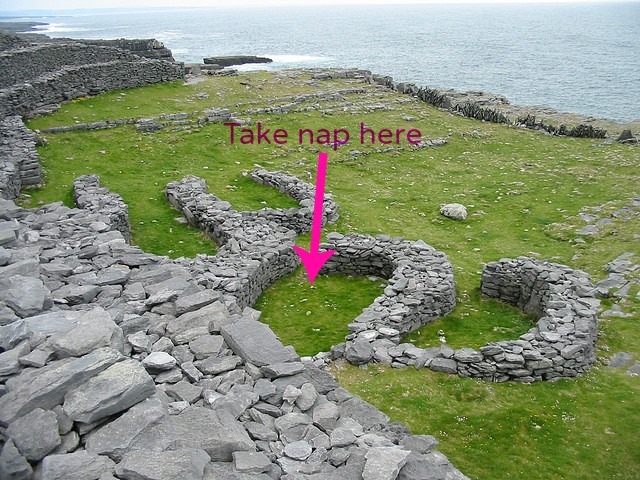
After lunch, and after the car was unloaded and the beds made and the groceries put away… we napped. As you do when you are content, and chilled, and knowing that the ocean is scouring the shore just a short walk away.

Some years ago–a lifetime ago–I took a nap on the other shore of the Atlantic, in the sheltering crook of a wall at Dún Dúchathair, to the tune of the wind and the waves.

Now we’re awake, and the evening is waiting, and Seamus Heaney, who knows something about cold rocks, windswept shores, and putting a few words together, is celebrating his birthday on that other shore (or so I imagine; he could be sitting in a coffee shop in Indianapolis, for all I know).

Lovers on Aran

The timeless waves, bright, sifting, broken glass,
Came dazzling around, into the rocks,
Came glinting, sifting from the Americas

To posess Aran. Or did Aran rush
to throw wide arms of rock around a tide
That yielded with an ebb, with a soft crash?

Did sea define the land or land the sea?
Each drew new meaning from the waves’ collision.
Sea broke on land to full identity.

–Seamus Heaney

Save me a seat in the balcony

In memory of Roger Ebert, June 18, 1942 – April 4, 2013.

Ave Maria

Mothers of America
                                     let your kids go to the movies!
get them out of the house so they won’t know what you’re up to
it’s true that fresh air is good for the body
                                                                             but what about the soul
that grows in darkness, embossed by silvery images
and when you grow old as grow old you must
                                                                            they won’t hate you
they won’t criticize you they won’t know
                                                                            they’ll be in some glamorous country
they first saw on a Saturday afternoon or playing hookey
they may even be grateful to you
                                                            for their first sexual experience
which only cost you a quarter
                                                       and didn’t upset the peaceful home
they will know where candy bars come from
                                                                                 and gratuitous bags of popcorn
as gratuitous as leaving the movie before it’s over
with a pleasant stranger whose apartment is in the Heaven on Earth Bldg
near the Williamsburg Bridge
                                                       oh mothers you will have made the little tykes
so happy because if nobody does pick them up in the movies
they won’t know the difference
                                                         and if somebody does it’ll be sheer gravy
and they’ll have been truly entertained either way
instead of hanging around the yard
                                                                 or up in their room
                                                                                                     hating you
prematurely since you won’t have done anything horribly mean yet
except keeping them from the darker joys
                                                                             it’s unforgivable the latter
so don’t blame me if you won’t take this advice
                                                                                      and the family breaks up
and your children grow old and blind in front of a TV set
                                                                                                        seeing
movies you wouldn’t let them see when they were young


–Frank O’Hara, from Lunch Poems. Copyright © 1964 by Frank O’Hara.

And I love the rain

Rain

Splash

April Rain Song

Let the rain kiss you.
Let the rain beat upon your head with silver liquid drops.
Let the rain sing you a lullaby.

The rain makes still pools on the sidewalk.
The rain makes running pools in the gutter.
The rain plays a little sleep-song on our roof at night—

And I love the rain.

–Langston Hughes, from Collected Poems. Copyright © 1994 by the Estate of Langston Hughes.

Raindrops

Because it’s raining today, and it’s the start of April, and it’s National Poetry Month, let’s stand out on the deck, hold the bucket out, let it fill with poems, and get a bit drenched.

As I did last April, I’ll update this post every day this month with a link to a different poem.

April 1 ~ April Rain Song ~ Langston Hughes
April 2 ~ Instructions for how to get ahead of yourself while the light still shines ~ Jenny Bornholdt
April 3 ~ Things keep sorting themselves ~ Jane Hirshfield
April 4 ~ Thinking of Madame Bovary ~ Jane Kenyon
April 5 ~ Ave Maria ~ Frank O’Hara
April 6 ~ Gic to Har ~ Kenneth Rexroth
April 7 ~ Sphere – Kate Gale
April 8 ~ One Day ~ Robert Creeley
April 9 ~ The Mower’s Song ~ Andrew Marvell
April 10 ~ The Things ~ Donald Hall
April 11 ~ Here ~ Grace Paley
April 12 ~ General Prologue, The Canterbury Tales ~ Geoffrey Chaucer
April 13 ~ Lovers on Aran ~ Seamus Heaney
April 14 ~ I Started Early – Took my Dog ~ Emily Dickinson
April 15 ~ Oystering ~ Richard Howard
April 16 ~ A River ~ John Poch
April 17 ~ Rules for Captain Ahab’s Provincetown Poetry Workshop ~ Martin Espada
April 18 ~ Early Morning: Cape Cod ~ May Swenson
April 19 ~ The Peace of Wild Things ~ Wendell Berry
April 20 ~ A Recipe for Whisky ~ Ron Butlin
April 21 ~ Pied Beauty ~ Gerard Manley Hopkins
April 22 ~ Earth Day ~ Jane Yolen
April 23 ~ A Cold Spring ~ Elizabeth Bishop
April 24 ~ Musée des Beaux Arts ~ W. H. Auden
April 25 ~ Musée de Beaux Arts Revisited ~ Billy Collins
April 26 ~ Ulysses ~ Alfred, Lord Tennyson
April 27 ~ Edward Hopper’s New York Movie ~ Joseph Stanton
April 28 ~ Some days (For Paula) ~ James Baldwin
April 29 ~ A Dish of Peaches from Russia ~ Wallace Stevens
Arpil 30 ~ The Shape of the Air Around the Girl in the Birchbark Canoe ~ Annie Dillard

Here, and nearly there

Winter and spring

There are so many tictoc

there are so many tictoc
clocks everywhere telling people
what toctic time it is for
tictic instance five toc minutes toc
past six tic

Spring is not regulated and does
not get out of order nor do
its hands a little jerking move
over numbers slowly

we do not
wind it up it has no weights
springs wheels inside of
its slender self no indeed dear
nothing of the kind.

(So,when kiss Spring comes
we’ll kiss each kiss other on kiss the kiss
lips because tic clocks toc don’t make
a toctic difference
to kisskiss you and to
kiss me)

–e. e. cummings

On the last day of January

Bend

I’ve been thinking about Wallace Steven’s poem, The Snow Man, for weeks now, because, of course, it’s winter and it’s January.

I wanted to write something about having a “mind of winter”, expecting to have experienced it, even for just a day, as I have in winters before.

But this January’s rickrack weather hasn’t cooperated. It’s too ragged and unpredictable for me to have relaxed into the rhythm of ice and snow, the logs being fed methodically into the wood stove, the shovel scraping the driveway, the sliding of one ski past the other on the trail, the shuffling of snowshoes up and over the snow-plowed mound at the end of the driveway.

Field

Instead, we’ve swung from -25 degrees one day to +50 degrees another, from snow to rain to ice to sun and blue skies, from sequin-scattered snow to squeaky styro-foam snow to fog, slush, mush, mud.

How can I settle into that mesmeration of cold, still resilience, with all of this meteorological commotion?

As much as I resent the oncoming of winter (I have a mind of spring), there’s something to be said for that band of weeks against which you can do nothing but read, sit by the fire, make soup and bread, and be excused up to bed early just because it’s dark by 4.30.

January woods

The yard and garden are silent. The animals understand if you don’t want to play outside; they’re in hunker-down mode, too. You’re vaguely aware of plans that need or ought to be made, for some future time when the cold is cracked open and seedlings sprout, but… not yet. Not yet.

Tonight, just pull the covers up to your chin, listen to the wind roar, watch the flakes flutter down.

Snow river

I’m greedy for that mental state: the whirling world putting a kind hand on my shoulder, telling me that nothing at all is required.

The wind is whistling across the yard now and the temperature is dropping again.

The wind slammed the barn door hard this morning when I was inside loading hay into the feeders. The goats were munching gently and they didn’t seem bothered by the wind and the noise. All they were interested in was the hay, and the animal crackers in the cookie jar, and a good rub against their foreheads.

It was warm enough this morning that I lingered there, jealous of the cozy barn and their herdness, and grateful for the way they welcome me into that herd though I’m clearly not a normal goat. And while I was there, I lost for a bit that mental list of things to do, or what was outside, or what was coming in an hour, or where I had failed or what I had meant to do and be.

That moment, and the true locked-down January, are like the hours of travel from here to there, when the only point is the movement. Nothing else is required. Nothing.